

How to Wear a Ring on Each Finger: A Men's Styling Guide
Owning a few rings is easy. Wearing more than one without looking like you raided a pirate chest is where most guys freeze.
This is the practical side — how many rings to wear, which finger suits which ring, how to mix metals without clashing, and how to get the fit right so a stack looks deliberate instead of accidental. For what each finger symbolises, that's a separate guide, linked below.
How Many Rings Should a Man Wear?
There's no magic number, but there is a simple test: if you can't comfortably close your fist, you've got too many on. Beyond that, most men land on two to three rings per hand for everyday wear, scaling up to four or five across both hands for a night out or an event.
| Setting | Rings (total) | Approach |
|---|---|---|
| Everyday / work | 1–2 | One anchor per hand; keep it low-profile |
| Weekend / casual | 3–4 | Mix textures — polished next to oxidised |
| Going out / events | 4–6 | Add a thumb ring, play with widths and contrast |
The trick is that these all scale from the same core pieces — you don't need separate sets. Start with the ring you already wear every day, then add one at a time. If a new one feels crowded or heavy, trust that and pull it back off.
Which Finger for Which Ring
This is about which type of ring looks right where — not what each finger means. (For the symbolism — leadership, love, willpower and the rest — see our guide to what rings mean on each finger.) For styling, match the ring to the finger's size and role:
| Finger | Ring style that works | Why |
|---|---|---|
| Thumb | Wide, chunky band | Sturdy and set apart — carries bulk well; size it separately, it's larger |
| Index | Bold signet or crest | Assertive and visible; reads confident without needing a stone |
| Middle | Your biggest statement piece | Longest, strongest finger — holds a large ring in proportion |
| Ring | Plain band, or keep it clean | If you wear a wedding band, leave this finger simple |
| Pinky | Slim band or a single signet | Small finger; a delicate ring or one flashy statement, not a crowd |
Balance, Spacing and Rhythm
The difference between "styled" and "cluttered" is almost always spacing. Three rules do most of the work:
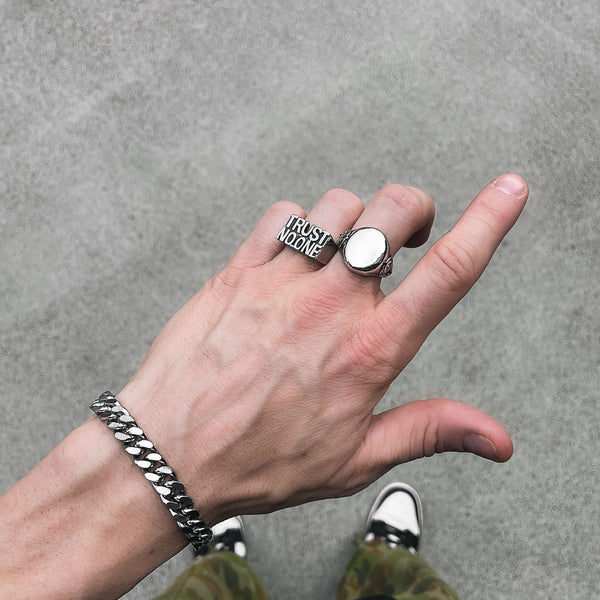
- Leave a bare finger between rings. Index and ring with a gap in the middle; thumb and middle. The gap gives your eye somewhere to rest — without it, the rings blur into a metal wall. Adjacent rings on every finger only work if you're deliberately going maximalist.
- Let one hand dominate. Spread rings across both hands but weight one heavier — say two on one hand, one on the other. And put your daily, durable pieces on your dominant hand, since it takes the knocks; keep detailed or sentimental rings on the other.
- Don't sit two statement rings side by side. Two bold pieces on adjacent fingers fight for attention. If you want two show-stoppers, split them across your hands.
Factor in your wrist, too. If you wear a watch or a stack of bracelets on one side, go lighter on rings there so the metal doesn't pile up on a single hand.
Mixing Metals Without Clashing
The old "never mix metals" rule is dead. Silver next to gold, steel beside brass — all fair game now, as long as it looks intentional. The way to keep it deliberate is to let one metal dominate: roughly a 2-to-1 ratio, two pieces in your main metal and one as an accent. A two-tone ring makes a natural bridge between the two.
There's one practical catch most style guides skip: hardness. Every metal sits at a different point on the Mohs hardness scale — stainless steel around 5–6, titanium 6, versus softer gold and silver around 2.5–4. When a harder ring rubs against a softer one all day, the harder metal slowly wears the softer down. So if you're mixing metals of very different hardness, keep them on separate fingers rather than stacked together, or mix across your two hands instead of on the same one.
Choosing Your Metal (and Sensitive Skin)
What your rings are made of decides how they wear and how they age. The quick version: silver is flexible and easy to coordinate; gold brings warmth; titanium is light and near-indestructible; and stainless steel is affordable, scratch-resistant and sleek — which is why it holds up so well in a daily stack.
Metal matters more if your skin reacts to jewellery. Nickel is behind the vast majority of jewellery skin reactions — the American Academy of Dermatology estimates more than 18% of people in North America are allergic to it. For sensitive skin, Mayo Clinic recommends surgical-grade stainless steel, titanium, high-karat gold or sterling silver.
Statement Collective rings are made from 316L surgical-grade stainless steel — the same alloy used for its skin-friendliness in the medical world. It's a stable, low-nickel-release metal, so it's waterproof, non-tarnish and hypoallergenic for the vast majority of wearers, and hard enough to survive a daily stack without scratching up. If you have a diagnosed severe nickel allergy, titanium is the safest bet of all. Build your stack from the rings and wider men's jewellery range.
Stacking Two Rings on One Finger
Stacking on a single finger is where a look goes from "wearing rings" to "styled." Two rules make it work:
- Mix the widths. A slim band under a wider one reads intentional; two identical bands just look like one thick ring that went wrong. Pair a 2–3mm band with a chunkier statement piece.
- Size up on the bottom. The ring underneath has to clear the knuckle carrying the one above it, so go up about half a size on the lower ring. Otherwise the stack won't slide on, or it'll pinch once it's there.
Keep single-finger stacks to two, maybe three rings, and don't stack over-detailed pieces — the standout design just gets hidden by its neighbours.
Fit, Occasions and Common Mistakes
Fit is non-negotiable. A loose ring spins, and a spinning ring knocks against its neighbours all day — that's how you get scratches and that annoying click. Each ring should clear the knuckle with a little resistance and sit snug at the base. If one's slightly loose, here's how to make a ring smaller without resizing, and our sizing guide helps you get it right first time. If you work with your hands, keep low-profile bands without raised settings that snag.
The mistakes to avoid:
- Wearing identical widths — the stack looks like pipe fittings. Vary thin, medium and statement.
- Stacking on every finger — it reads costume, not considered.
- Two statement rings on adjacent fingers — they compete; split them.
- Ignoring fit — loose rings spin, scratch and vanish into a drawer by noon.
- Forgetting grooming — rings draw every eye straight to your nails and cuticles.
Frequently Asked Questions
How many rings should a man wear?
Can a man wear a ring on every finger?
How do you stack rings?
Can you mix gold and silver rings?
Which finger should a man wear a ring on?
How do you wear multiple rings without it looking like too much?
Should you wear rings on your dominant hand?
How do you stack two rings on one finger?
What is the best metal for men's rings if you have sensitive skin?
How should rings fit for stacking?
Can you wear rings with a watch?
What are the most common ring-stacking mistakes?
The Bottom Line
Wearing rings well isn't about rules — it's about a few habits. Keep the count in check, mix your widths, leave a gap, let one metal lead, and make sure everything actually fits. Do that and even a big stack reads as deliberate.
Start with one ring you love and build from there. Browse our rings and the full collection, and if you want to know what your placement actually signals, read what rings mean on each finger next.
%0AStacking%20two%20ring...)